How to Build a Long-Term Brand With a Digital Marketing Strategy
Getting your first customer online can feel like a big achievement.
But building a brand that people remember is a completely different challenge.
You can run an ad today and get 20 leads.
You can publish a Reel and get 100,000 views.
You can write an article and suddenly receive traffic from Google.
But what happens next month?
And next year?
That’s where brand building becomes important.
A long-term digital marketing strategy isn’t about finding one magic channel that generates endless traffic.
It’s about building several assets that become more valuable over time.
What is a long-term digital marketing strategy?
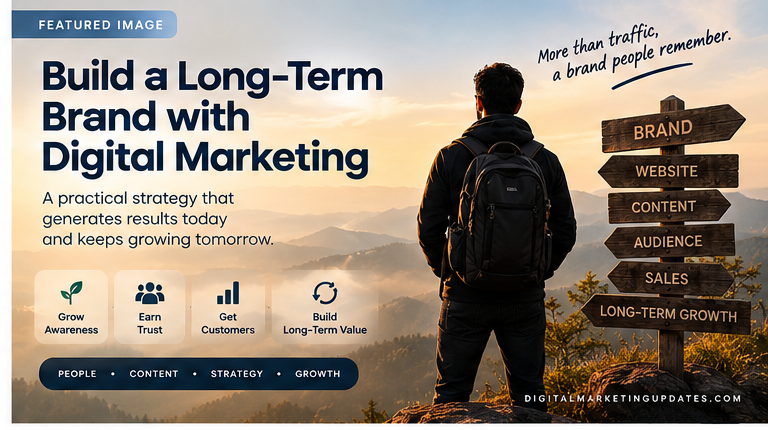
A long-term strategy is a marketing system designed to generate results today while also building assets for the future.
For example:
Short-term
Google Ads → leads → sales
Long-term
SEO → content → organic traffic → email subscribers → returning visitors → customers
You ideally want both.
Paid advertising can help you get attention quickly.
SEO and content can help you build an asset that continues attracting people after the original work is done.
1. Start with a clear positioning
Before worrying about Instagram, Google Ads or SEO, answer one question:
Why should someone choose you?
Let’s say you sell digital marketing services.
There are thousands of agencies offering:
SEO
Google Ads
Social Media Marketing
Website Development
That’s not particularly memorable.
Now imagine saying:
“We help small Indian businesses generate their first 100 qualified leads online.”
That’s more specific.
Your positioning doesn’t need to be complicated.
It needs to tell people:
Who are you helping?
What problem do you solve?
Why should they listen to you?
2. Build your website as an asset
Your website shouldn’t simply be an online brochure.
It can become your marketing headquarters.
For example:
Homepage
↓
SEO guides
↓
Marketing calculators
↓
AI tools
↓
Email newsletter
↓
Affiliate recommendations
↓
Lead generation
↓
Products/services
Every useful page becomes another opportunity for someone to discover your brand.
That’s exactly why we’re building DigitalMarketingUpdates.com around content + tools + resources, rather than treating it as a simple blog.
3. Create content that answers real problems
Don’t publish articles because you haven’t posted anything this week.
Publish because your audience has a question.
For example:
Bad topic:
“Digital Marketing Trends”
Better:
“7 Digital Marketing Changes Small Businesses Should Pay Attention to in 2026”
Even better:
“I Have ₹30,000 a Month for Marketing. Where Should I Spend It?”
The last topic immediately creates a scenario.
A reader can see themselves in it.
4. Don’t depend on one platform
This is one of the biggest mistakes businesses make.
Imagine your entire business depends on Instagram.
Then your reach drops.
Or your account gets restricted.
Or the algorithm changes.
Your business shouldn’t collapse.
Instead:
↓
Website
↓
Email list
↓
YouTube
↓
↓
↓
Community
Each channel can support the others.
5. Turn one piece of content into many
You don’t need to create everything from scratch.
Suppose you publish:
“Complete Google Ads Budget Guide.”
You can turn it into:
Website
Full article
YouTube
10-minute video
5-slide carousel
Budget allocation post
Short video
“3 Google Ads budgeting mistakes”
One practical tip
Calculator
Google Ads budget calculator
One idea becomes an entire content system.
This is much more sustainable than trying to invent a completely new topic every day.
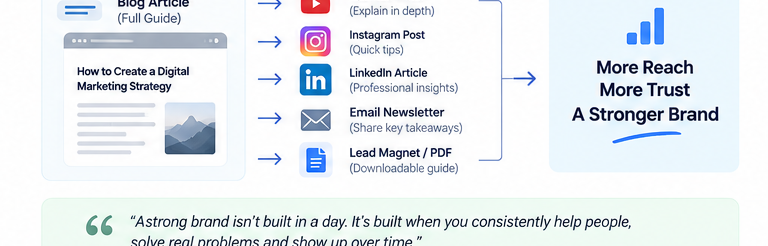
One useful idea can be adapted into multiple formats and channels without simply copying the same content everywhere.
6. Use SEO to build long-term traffic
Paid advertising stops when you stop paying.
SEO can continue producing traffic after the original article has been published.
That doesn’t mean SEO is free or effortless.
It requires:
- research
- content
- technical optimisation
- internal linking
- updating
- patience
But a successful article can become a long-term acquisition asset.
For example, if you publish a useful:
Digital Marketing ROI Calculator
and people continually search for similar calculations, that tool can potentially attract visitors month after month.
That’s an asset.
7. Build an email list
One of the most valuable things a website can build isn’t traffic.
It’s a relationship.
Someone visits your website today.
They leave.
You may never see them again.
But if they voluntarily subscribe to your newsletter, you have another opportunity to provide value later.
Your email could contain:
This week’s 3 useful marketing ideas
- One SEO tip
- One AI tool
- One advertising insight
Simple.
You don’t need to send a 2,000-word newsletter every day.
8. Build trust before asking for the sale
Imagine two websites.
Website A:
BUY NOW
BUY NOW
SPECIAL OFFER
LIMITED OFFER
Website B:
Here’s how to solve your problem.
Then:
Here’s a free calculator.
Then:
Here’s a detailed guide.
Then:
Here’s the tool we use.
Then:
If you want to try it, here’s our partner link.
Which relationship feels more natural?
The second one.
That’s how I would approach affiliate marketing on DigitalMarketingUpdates.com.
Help first. Recommend second.
9. Use paid advertising intelligently
Paid advertising still has an important role in a long-term strategy.
But don’t use ads simply because:
“We need traffic.”
Know what you’re trying to achieve.
For example:
Campaign A
₹10,000
Goal:
Generate leads
Campaign B
₹5,000
Goal:
Retarget website visitors
Campaign C
₹5,000
Goal:
Test a new audience
Now you have a reason behind the budget.
And once you have enough data, you can make better decisions.
10. Build recognizable brand assets
A brand isn’t just a logo.
It’s the combination of:
- visual identity
- tone of voice
- expertise
- consistency
- customer experience
- reputation
- content
For DigitalMarketingUpdates.com, we can gradually build recognizable assets such as:
Digital Marketing Updates
→ Free Marketing Calculators
→ AI Marketing Hub
→ Marketing Fix Finder
→ Weekly Marketing Insights
→ Tool Reviews
These can eventually become recognizable parts of the brand.
11. Track the numbers that actually matter
Don’t measure your entire business using followers.
You might have:
20,000 followers
and very little revenue.
Or:
2,000 visitors
and a strong conversion rate.
Track:
- organic traffic
- email subscribers
- leads
- conversion rate
- customer acquisition cost
- revenue
- affiliate commissions
- returning visitors
The numbers you track should connect back to the business.
12. Keep improving old content
One of the easiest opportunities many websites ignore is their existing content.
Imagine you published an article in 2024.
Since then:
- Google changed something
- new tools appeared
- new examples became available
- your own experience improved
Don’t simply publish another article.
Sometimes update the existing one.
Add:
2026 update
Then improve:
- examples
- screenshots
- statistics
- links
- explanations
- tools
- FAQs
That can make an old article useful again.
13. Think in years, not weeks
This is probably the hardest part.
You publish an article.
Nothing happens.
You publish another.
Still very little happens.
It can be tempting to conclude:
“SEO doesn’t work.”
But a brand isn’t normally built from one article.
Think about it as building a library.
One book isn’t very impressive.
100 genuinely useful books?
Now you have a resource.
Your website works similarly.
Every useful:
article + tool + video + email + guide + case study
adds another asset.
Over time, they can support each other.
A simple long-term digital marketing framework
Here’s the framework I’d recommend:
1. Attract
SEO
YouTube
Social media
Paid advertising
↓
2. Help
Articles
Videos
Calculators
Guides
AI tools
↓
3. Capture
Email newsletter
Lead magnet
Community
↓
4. Build trust
Consistent content
Real examples
Case studies
Reviews
↓
5. Monetize
Services
Affiliate marketing
Digital products
Courses
Sponsorships
↓
6. Retain
Email
Community
Useful updates
Repeat purchases
That’s a marketing system, not just a collection of campaigns.
Final thoughts
A strong digital brand isn’t built by constantly chasing the newest platform.
It’s built by creating something useful and making it easier for the right people to discover it.
Google will change.
Social algorithms will change.
AI tools will change.
Advertising platforms will change.
Your strategy should be flexible enough to change with them.
But the fundamentals remain surprisingly simple:
Understand your audience.
Solve real problems.
Create useful content.
Build owned assets.
Earn trust.
Measure what matters.
Keep improving.
That’s how you build something that can last.