Best Marketing Funnel Software for Small Businesses in 2026
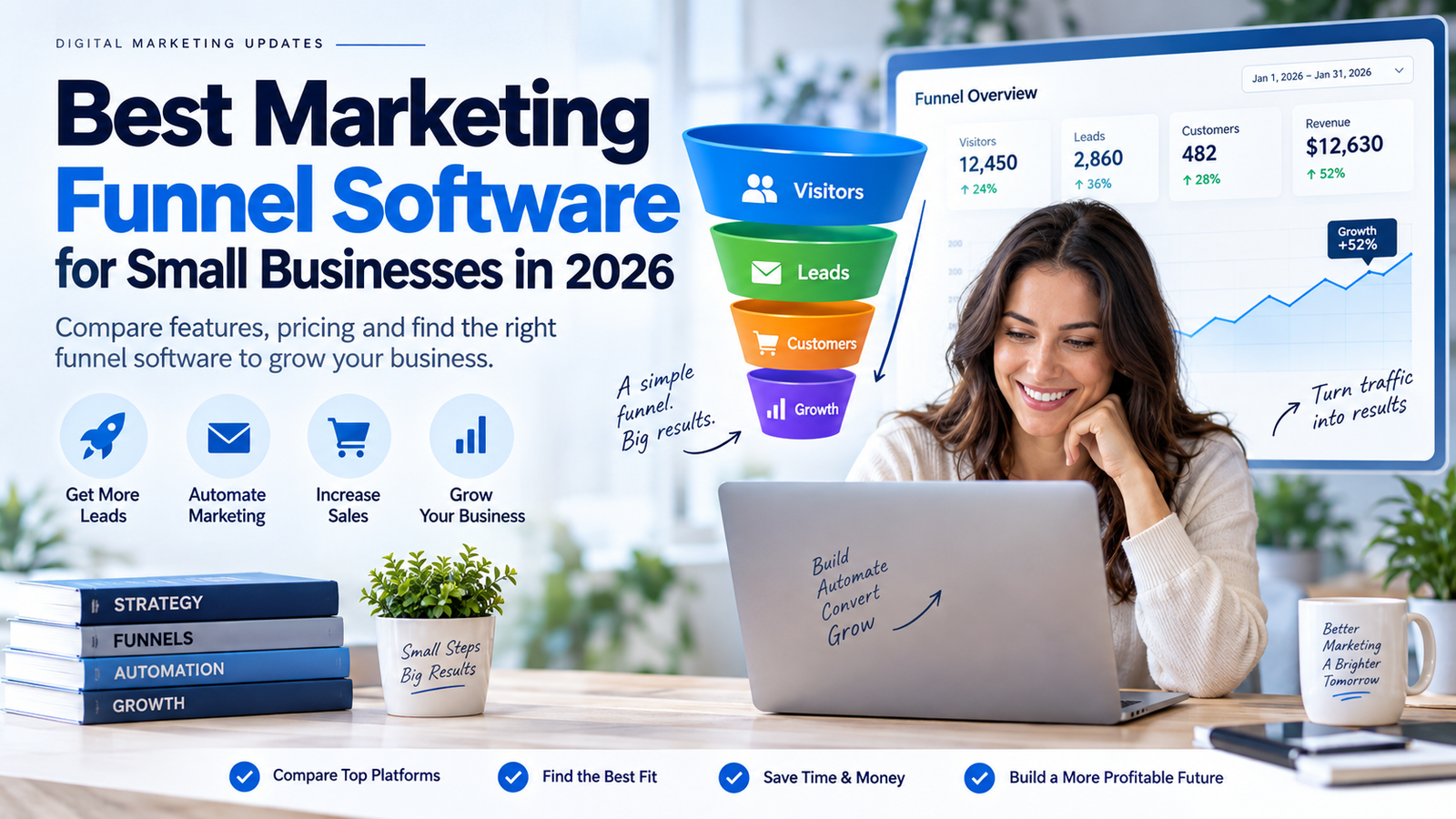
Choosing the right marketing funnel software can make it easier to attract visitors, capture leads, automate follow-ups and turn prospects into customers. But not every business needs the same type of funnel platform.
Some businesses need a simple landing page and email sequence. Others need sales funnels, checkout pages, automation, courses, webinars, CRM functionality or affiliate management.
In this blog, we’ll compare several popular marketing funnel software options for small businesses in 2026, explain what each platform is designed for, and show you what to consider before choosing one.
Disclosure: This article contains affiliate links. If you purchase a product through an affiliate link, we may receive a commission at no additional cost to you. Our comparisons are based on publicly available product information and are intended to help you evaluate your options.
What Is Marketing Funnel Software?
Marketing funnel software is a platform that helps businesses build and manage the different stages of a customer journey.
A typical funnel might look like this:
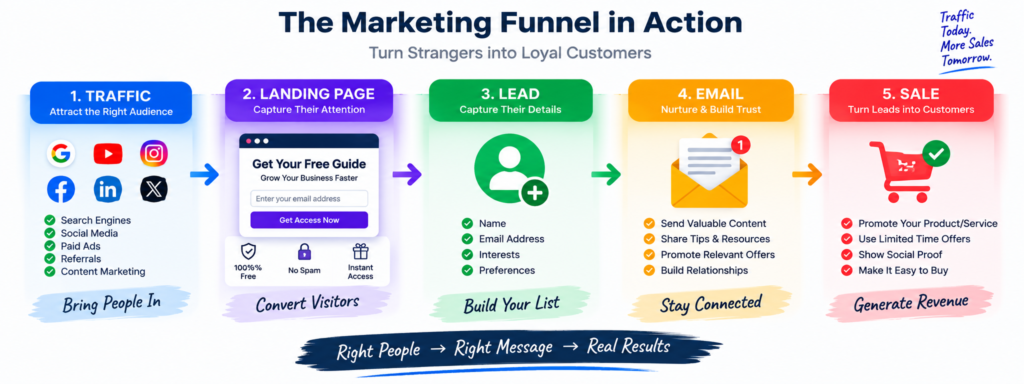
Traffic → Landing Page → Lead Capture → Email Follow-Up → Offer → Purchase
Instead of using separate tools for every stage, funnel software can combine some or many of these functions in one platform.
Depending on the software, you may get features such as:
- Landing page builders
- Sales funnel builders
- Lead capture forms
- Email marketing
- Marketing automation
- Checkout pages
- Payment processing
- Upsells and order bumps
- A/B testing
- Analytics
- Online courses
- Webinars
- Affiliate management
- Customer relationship management
The important point is that more features don’t automatically mean a better fit.
The right choice depends on your business model, budget, technical requirements and the type of customer journey you want to create.
What Should Small Businesses Look for in Funnel Software?
Before comparing platforms, consider these seven areas.
1. Funnel Builder
The platform should make it relatively easy to create pages and connect them into a customer journey.
For example:
Advertisement → Landing Page → Lead Form → Thank You Page → Email Sequence → Sales Page
A visual funnel builder can make this process easier to manage.
2. Landing Pages
Look for:
- Drag-and-drop editing
- Mobile responsiveness
- Templates
- Custom domains
- Forms
- Conversion tracking
- A/B testing where appropriate
Your landing page is often the first major conversion point in the funnel.
3. Email Marketing and Automation
Capturing a lead is only the beginning.
Good funnel software should allow you to follow up with prospects through:
- Welcome emails
- Educational sequences
- Product recommendations
- Abandoned-cart messages
- Promotional campaigns
- Automated workflows
4. Payments and Checkout
If you’re selling products, services or digital products, check whether the platform supports the payment methods and checkout experience your customers need.
5. Analytics
You should be able to understand what happens after visitors enter your funnel.
At minimum, track:
Visitors → Leads → Sales
You can also calculate important metrics such as:
- Conversion rate
- Cost per click
- Cost per acquisition
- Return on investment
- Customer value
You can use our free Digital Marketing Calculator to calculate several of these marketing metrics.
6. Integrations
Check whether the platform integrates with the tools you already use.
Depending on your business, that could include:
- Google Analytics
- Payment gateways
- Email platforms
- CRM systems
- Webinar platforms
- Zapier
- Google Sheets
- Advertising platforms
7. Pricing as You Grow
Don’t only look at the introductory price.
Ask:
- How many contacts are included?
- How many funnels can I create?
- Are emails limited?
- Are there transaction fees?
- Are additional users charged?
- Does the price increase as my contact list grows?
- Are important features restricted to higher plans?
This is particularly important for small businesses because software costs can increase as the business grows.
Best Marketing Funnel Software for Small Businesses
There isn’t one platform that fits every business.
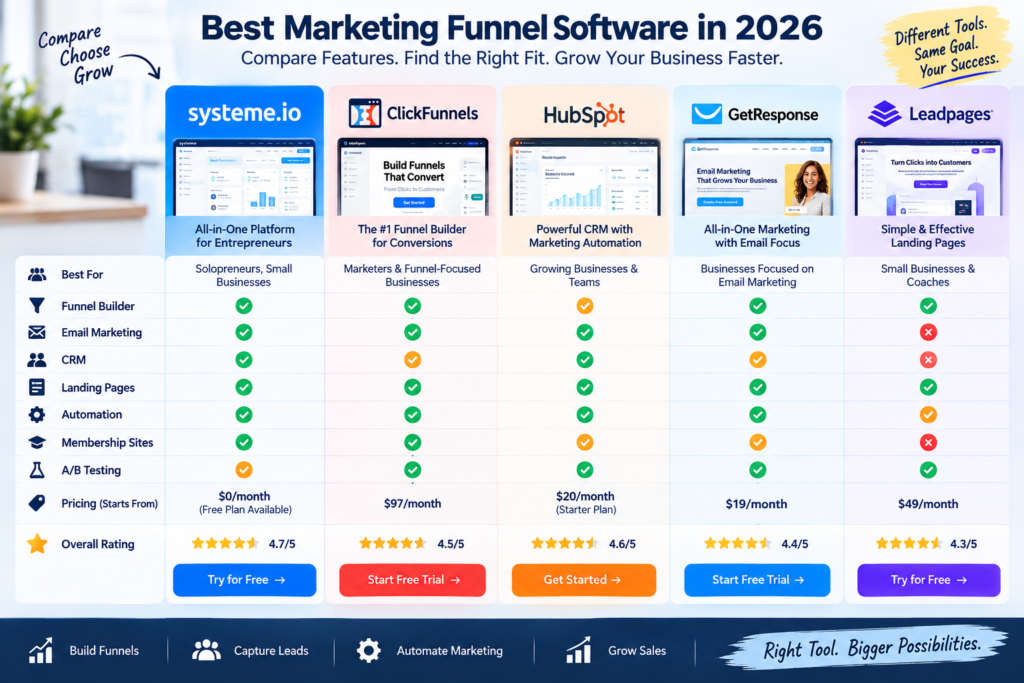
Here are several platforms worth considering.
Systeme.io
Best suited to: Entrepreneurs and small businesses looking for an all-in-one platform.
Systeme.io combines several marketing functions within one platform, including sales funnels, email marketing, website building, marketing automation, online courses, webinars and affiliate management.
One of its notable characteristics is that the free plan is designed to let users start without a paid subscription. The official pricing page currently lists:
- Free: $0/month
- Startup: $17/month
- Webinar: $47/month
- Unlimited: $97/month
The current free plan includes up to 2,000 contacts and three sales funnels, while higher plans increase contact and funnel limits. Systeme.io also states that its plans include unlimited email sending and no transaction fees.
Key features
- Sales funnels
- Email marketing
- Marketing automation
- Website builder
- Online courses
- Webinars
- Affiliate management
- Booking calendar
- Product selling
- Community features
Potential advantages
For a small business, combining multiple functions into one platform can reduce the need to subscribe to several separate tools.
The free plan can also allow a business to experiment with funnel building before committing to a paid subscription.
Things to consider
Businesses with more advanced CRM requirements, complex enterprise workflows or large teams may need a more specialized platform.
Who should consider Systeme.io?
It can be worth evaluating if you are:
- A solo entrepreneur
- A creator
- A coach
- An affiliate marketer
- A course creator
- A small online business
- A freelancer or consultant
Interested in trying Systeme.io?
Affiliate disclosure: This is an affiliate link. We may earn a commission if you purchase through it.
ClickFunnels
Best suited to: Businesses that want a dedicated funnel-building platform with advanced sales-funnel functionality.
ClickFunnels is focused heavily on building sales funnels and includes tools for websites, landing pages, courses, stores and related marketing activities.
Its current 2026 pricing page lists:
- Launch: $97/month
- Scale: $197/month
- Optimize: $297/month
Annual billing displays lower effective monthly pricing. The plans vary by contacts, email volume, workspaces, team members and other capabilities.
Key features
- Sales funnels
- Landing pages
- Websites
- Email capabilities
- Courses
- Stores
- Custom domains
- AI tools
- Team collaboration
- API/webhooks on higher tiers
Potential advantages
ClickFunnels can be useful for businesses that want a platform centered around sales funnels and need more advanced funnel functionality.
Things to consider
The subscription cost can be significantly higher than entry-level all-in-one platforms, particularly for a small business operating with a limited software budget.
HubSpot
Best suited to: Businesses that need CRM, marketing automation and broader customer-management functionality.
HubSpot takes a broader approach than a dedicated funnel builder. Its ecosystem includes CRM, marketing, sales, service, content and other business tools.
Its current pricing structure varies considerably by product, tier, seats and marketing-contact requirements. HubSpot’s current documentation shows a free offering and paid tiers, while higher-level Marketing Hub plans can become substantially more expensive.
Key features
- CRM
- Lead management
- Marketing automation
- Email marketing
- Forms
- Landing pages
- Analytics
- Customer management
- Sales tools
- AI-powered features
Potential advantages
HubSpot can make sense when customer relationship management is as important as the funnel itself.
Things to consider
Pricing becomes more complex as contact volume, seats and advanced functionality increase. HubSpot also uses marketing-contact tiers that can affect subscription costs.
For a very small business that only needs a basic lead-generation funnel, the broader platform may provide more functionality than necessary.
Interested in trying Hubspot?
Affiliate disclosure: This is an affiliate link. We may earn a commission if you purchase through it.
GetResponse
Best suited to: Businesses that place strong emphasis on email marketing and automation.
GetResponse has evolved from an email marketing platform into a broader marketing platform with features including automation, landing pages, ecommerce functionality, webinars and other marketing tools.
Key features
- Email marketing
- Marketing automation
- Landing pages
- Webinars
- Website tools
- Ecommerce functionality
- Segmentation
- Analytics
- AI-assisted marketing features
Potential advantages
If email marketing is at the center of your customer journey, GetResponse is a platform worth evaluating.
Things to consider
Pricing and available features depend on contact volume and plan level, so businesses should compare the exact features they need rather than simply comparing starting prices.
Leadpages
Best suited to: Businesses primarily focused on creating landing pages and lead-generation experiences.
Leadpages is particularly associated with landing pages and conversion-focused lead generation.
It can be useful when your primary requirement is creating landing pages rather than building a large all-in-one business-management system.
Key considerations
Before selecting Leadpages, determine whether you also need:
- Advanced email automation
- CRM functionality
- Course hosting
- Ecommerce
- Webinars
- Complex funnel workflows
If you need several of these functions, an all-in-one platform may be worth comparing.
Marketing Funnel Software Comparison
| Platform | Main strength | Suitable for | Funnel | Email/Automation | CRM |
|---|---|---|---|---|---|
| Systeme.io | All-in-one marketing | Entrepreneurs & small businesses | Yes | Yes | Limited compared with dedicated CRM platforms |
| ClickFunnels | Sales funnels | Funnel-focused businesses | Yes | Yes | More funnel-focused |
| HubSpot | CRM + marketing | Growing teams | Yes | Yes | Strong |
| GetResponse | Email + automation | Small businesses & creators | Yes | Strong | Available, but platform emphasis varies |
| Leadpages | Landing pages | Lead generation | Yes | Depends on setup | Integrations |
Note: Feature availability and limits vary by plan and can change. Always check the vendor’s current pricing and feature pages before purchasing.
How Much Does Marketing Funnel Software Cost?
The cost can range from free to hundreds of dollars per month, depending on the platform and the functionality you require.
For example, Systeme.io currently offers a free plan, with paid plans listed from $17/month on its official pricing page.
ClickFunnels currently lists paid plans beginning at $97/month when billed monthly, with lower effective pricing available on annual billing.
HubSpot has a much broader pricing structure, with entry-level options and substantially more expensive professional and enterprise offerings.
Therefore, don’t compare software purely by the advertised starting price.
Instead, calculate your total cost at your expected business size.
For example:
Software cost + email cost + CRM cost + landing-page cost + automation cost + payment fees
An all-in-one platform may be financially attractive if it replaces several separate subscriptions.
Do You Actually Need Marketing Funnel Software?
Not every business needs dedicated funnel software.
You may not need it if:
- You only have a simple website
- You receive most customers through referrals
- You don’t need automated email sequences
- You aren’t selling online
- Your customer journey is extremely short
However, funnel software becomes more useful when you need to:
- Capture leads
- Automatically follow up
- Sell digital products
- Build email sequences
- Create multiple landing pages
- Test different offers
- Track customer journeys
- Automate repetitive marketing tasks
How to Choose the Right Funnel Software
Use this five-step process.
Step 1: Define your funnel
Write down your customer journey.
For example:
Google Search → Blog → Lead Magnet → Email → Product
or:
Facebook Ad → Landing Page → Form → Sales Call
Step 2: Identify the tools you actually need
Don’t pay for functionality you won’t use.
Step 3: Calculate your expected contact volume
Many marketing platforms scale pricing based on contacts.
Step 4: Check integrations
Make sure the platform works with the tools you already use.
Step 5: Test before committing
Where a free plan or trial is available, build a small funnel before committing to a long-term subscription.
How to Build Your First Marketing Funnel
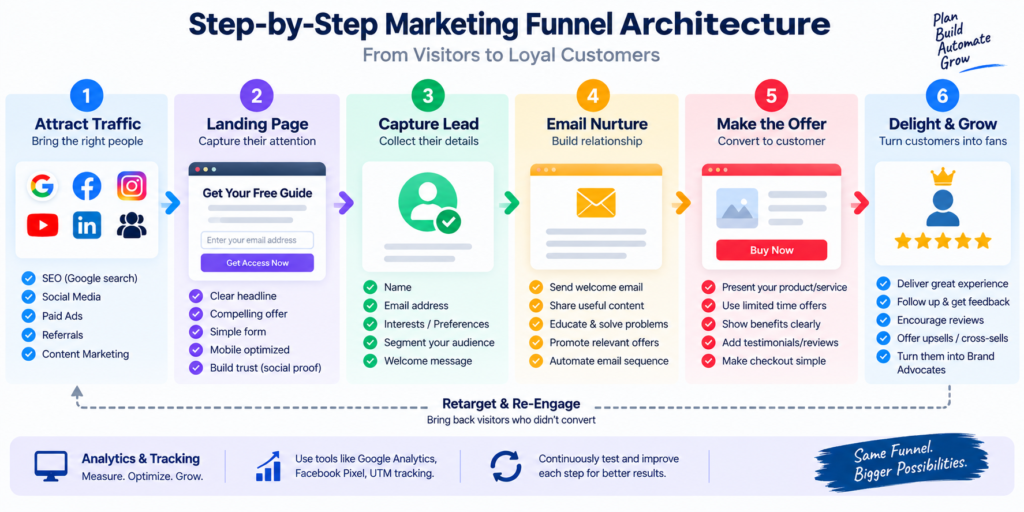
Once you’ve selected your platform, keep your first funnel simple.
A beginner-friendly funnel can look like:
Traffic
↓
Helpful Article
↓
Free Tool or Lead Magnet
↓
Landing Page
↓
Email Follow-Up
↓
Relevant Offer
↓
Customer
Don’t try to build a complicated 20-page funnel on your first attempt.
Start with one audience, one problem and one offer.
You can learn more about the process in our Marketing Funnel Guide.
And before optimizing the funnel, measure your key numbers using our free Digital Marketing Calculator.
Marketing Funnel Software for Different Business Models
For affiliate marketers
Look for:
- Landing pages
- Email automation
- Link tracking
- Audience segmentation
- Analytics
An all-in-one platform can reduce the number of separate subscriptions you need.
For coaches and consultants
Prioritize:
- Lead capture
- Appointment booking
- Email sequences
- Sales pages
- Payment processing
For course creators
Look for:
- Course hosting
- Student management
- Payment processing
- Email automation
- Upsells
- Membership functionality
For ecommerce businesses
Prioritize:
- Product pages
- Checkout
- Upsells
- Abandoned-cart recovery
- Customer segmentation
- Analytics
For agencies
Look for:
- Multiple workspaces
- Client management
- Automation
- Custom domains
- Integrations
- Team access
Frequently Asked Questions
What is the best marketing funnel software for a small business?
There is no universal choice for every small business. The appropriate platform depends on your required features, budget, contact volume, integrations and business model.
Systeme.io, ClickFunnels, HubSpot, GetResponse and Leadpages all approach funnel and marketing functionality differently.
Is marketing funnel software worth it?
It can be worthwhile when it replaces several separate tools or saves significant manual work.
Calculate the cost of the software against the time and subscriptions it could replace.
Can I build a marketing funnel for free?
Yes. Some platforms offer free plans or free trials. Systeme.io currently offers a free plan with limited funnel and contact capacity.
Is a sales funnel the same as a marketing funnel?
They overlap but aren’t always identical.
A marketing funnel generally describes the broader customer journey from awareness through conversion and retention.
A sales funnel usually focuses more specifically on moving prospects toward a purchase.
How many steps should a marketing funnel have?
There is no universal number.
A simple funnel might contain:
Landing Page → Lead Capture → Email → Offer
A more complex business may need additional steps.
Start simple and add complexity only when there is a clear reason.
What is the difference between a funnel builder and CRM?
A funnel builder focuses on creating and managing customer journeys and conversion pages.
A CRM focuses more heavily on storing customer information, managing relationships, tracking interactions and supporting sales processes.
Some modern platforms combine both types of functionality.
Final Thoughts
Marketing funnel software can help small businesses bring several parts of the customer journey together.
But the software itself isn’t the strategy.
Your results depend on factors such as:
Traffic + Offer + Funnel + Follow-Up + Measurement
Start by identifying the customer journey you actually need.
Then choose software that supports that journey without creating unnecessary cost or complexity.
If you’re just getting started, building a simple funnel and measuring its performance is usually more useful than immediately creating a complicated marketing system.
Ready to build your first funnel?
👉 Read our complete Marketing Funnel Guide
Or calculate your marketing numbers first: