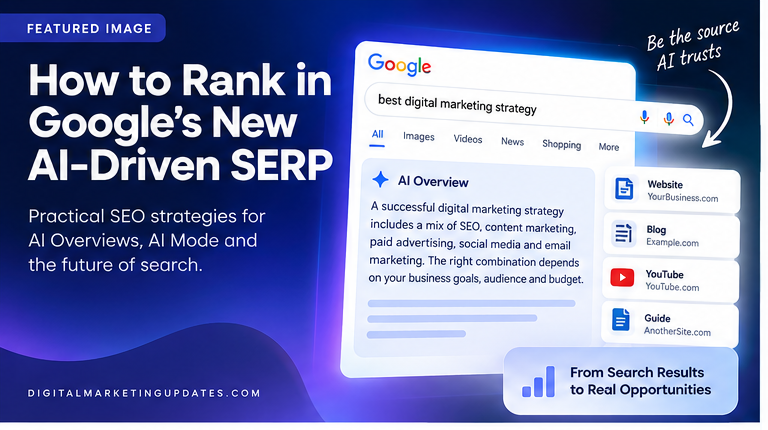
Google Search isn’t what it used to be.
A few years ago, the basic SEO goal was straightforward:
Get your page onto page one.
Today, someone searching for the same topic might see traditional results, an AI-generated overview, follow-up questions, videos, images, forums and other search features before they ever click a normal blue link.
That changes the way we need to think about SEO.
The goal isn’t simply to write an article and hope Google ranks it.
The goal is to create something useful enough that Google can understand it, users can trust it, and search systems have a reason to surface it.
Google itself has been adding guidance around AI Overviews, AI Mode and generative AI features in Search. Its documentation also makes clear that traditional SEO fundamentals still matter.
So, what should you actually do?
Let’s break it down.
What is Google’s AI-driven search?
Google’s newer search experiences can use AI to understand a query and provide a more conversational answer.
Instead of searching:
“best digital marketing strategy”
and simply receiving ten blue links, a user may ask:
“I’m a small business owner with ₹30,000 a month for marketing. What should I focus on first?”
That’s a much more complicated question.
Google needs to understand:
- what the person is actually asking
- their situation
- related concepts
- useful sources
- different aspects of the question
- information that supports the answer
This is one reason well-structured, genuinely useful content is becoming increasingly important.
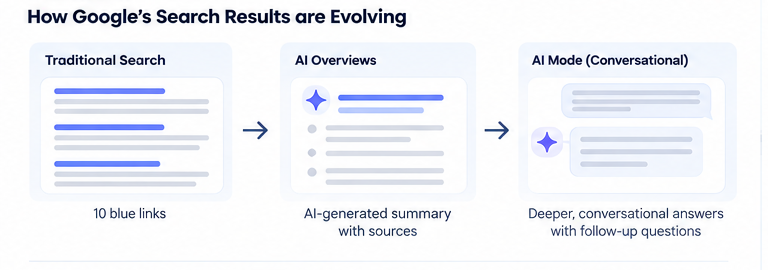
Google Search is evolving from traditional results toward more conversational and exploratory experiences.
Does this mean traditional SEO is dead?
No.
This is one of the biggest misconceptions surrounding AI search.
Google’s current documentation continues to emphasize SEO fundamentals while also providing specific guidance for generative AI search features.
Think about it this way.
If you run a restaurant, getting discovered through a new road doesn’t make the old roads disappear.
You simply have another route through which customers can find you.
The same idea applies to search.
You still need:
- crawlable pages
- useful content
- good internal linking
- clear page titles
- relevant topics
- strong user experience
- trustworthy information
- technically sound pages
But now you also need to think about whether your content actually answers the kinds of questions people ask conversationally.
1. Stop writing for keywords alone
This is probably the biggest change I’d make to your SEO strategy.
Imagine you want to rank for:
“Google Ads budget”
A traditional approach might produce an article containing the phrase dozens of times.
Something like:
Google Ads budget is important. Your Google Ads budget determines your Google Ads campaign performance…
It may contain the keyword.
But would anyone actually want to read it?
Probably not.
Instead, think about the problem behind the keyword.
Someone searching for “Google Ads budget” might actually want to know:
- How much should I spend?
- Is ₹500 per day enough?
- How much should a small business spend?
- Should I increase my budget?
- What happens if my campaign isn’t spending?
- How do I calculate the required budget?
Those questions should shape the article.
Better approach
Instead of:
“Google Ads Budget: Complete Guide”
you could create:
“How Much Should a Small Business Spend on Google Ads in 2026?”
Then actually answer the question.
For example:
If your business has ₹30,000 available every month, don’t automatically put the entire amount into Google Ads.
You might start with ₹15,000–₹20,000, keep the remaining amount for creative testing, landing-page improvements and retargeting, and increase the budget only after you know which campaigns are producing useful results.
That’s much more useful than repeating the phrase “Google Ads budget.”
2. Answer the main question quickly
Don’t make readers scroll through 1,500 words before getting the answer.
If someone searches:
“How do I improve CTR?”
give them a useful answer near the beginning.
For example:
The quickest way to improve CTR is usually to make your ad or search result more closely match the user’s intent. Test clearer headlines, stronger benefits and more specific messaging rather than simply adding more keywords.
Then explain the reasoning.
This structure is useful for both humans and search systems because the main answer is easy to identify.
3. Write like a human marketer
This is where I want DigitalMarketingUpdates.com to stand out.
Don’t write:
“In today’s rapidly evolving digital landscape, businesses must leverage cutting-edge strategies to maximize their online presence.”
Everyone has seen that sentence.
Instead:
“Most businesses don’t have a traffic problem. They have a focus problem.”
Much better.
Or:
“If you’re spending ₹50,000 a month on ads but don’t know which campaign actually generated your sales, increasing the budget isn’t the first thing I’d do.”
That’s something a real marketer might actually say.
4. Use real examples
This should become one of our biggest content advantages.
Instead of saying:
“Businesses should monitor conversion rates.”
Show the reader what that means.
Example
Imagine you’re running Google Ads for a website.
You spend:
₹20,000
You generate:
500 clicks
Your average CPC is:
₹40
Out of those 500 visitors:
20 become leads
Your conversion rate is:
4%
Now you have something useful to analyse.
Instead of immediately saying:
“Let’s increase the budget.”
You can ask:
Why are only 20 people converting?
Maybe:
- the landing page is weak
- the offer isn’t clear
- the traffic isn’t relevant
- the form is too long
- the campaign is targeting broad keywords
That’s what practical marketing content should teach.
5. Build topic depth, not isolated articles
Suppose DigitalMarketingUpdates.com publishes one article about:
AI SEO
Don’t stop there.
Build a content cluster.
Main guide
AI Search SEO: Complete Guide
Then supporting articles:
- How Google AI Overviews work
- How to optimise content for AI search
- AI search vs traditional Google Search
- What is AI Mode?
- Does FAQ content still help SEO?
- How to structure content for AI search
- How to measure AI search traffic
- Best AI SEO tools
- Common AI SEO mistakes
Now these articles can link to one another.
This creates a much stronger resource than publishing 20 unrelated SEO articles.
6. Add original information
This is extremely important.
If ten websites say:
“Use long-tail keywords.”
your article isn’t particularly different.
But what if you show:
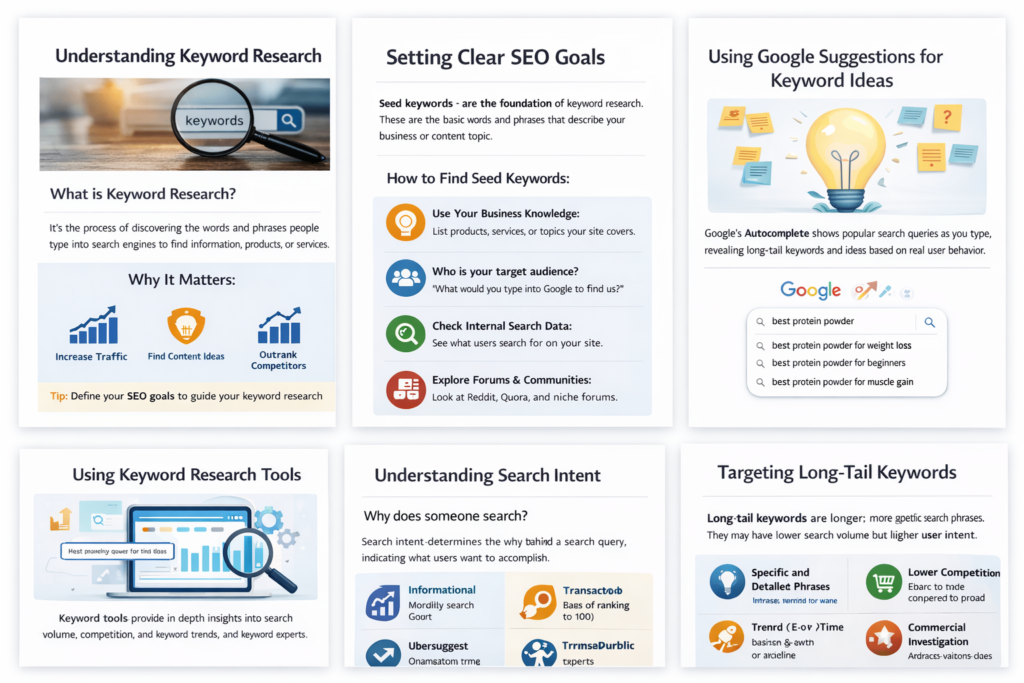
Example keyword research workflow
Keyword: digital marketing course
↓
Google autocomplete
↓
People Also Ask
↓
Reddit discussions
↓
Search Console queries
↓
Your existing articles
↓
Build a content outline
Now you’ve added a process.
That’s more useful.
Google’s current guidance specifically stresses the importance of providing unique, useful content rather than commodity material.
7. Use first-hand experience whenever possible
This is another area where you personally can give DigitalMarketingUpdates.com an advantage.
For example, instead of writing:
“Google Ads campaigns should be monitored regularly.”
We can write:
“When I manage a campaign, I don’t judge it by clicks alone. I usually start by looking at spend, conversions, cost per conversion and the quality of the leads. A campaign generating 100 leads isn’t necessarily better than one generating 30 leads if those 30 leads are much more valuable.”
That sounds like a marketer.
And it gives the reader something they can actually use.
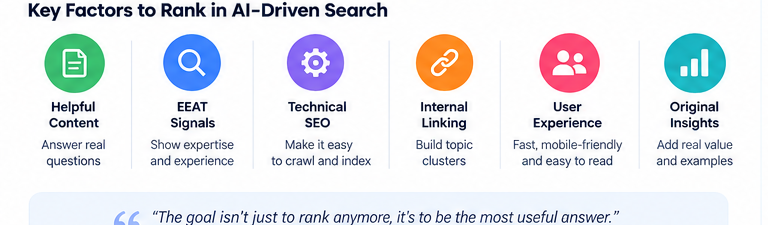
Strong SEO fundamentals work together when creating content for modern search experiences.
8. Don’t ignore technical SEO
AI search doesn’t mean technical SEO suddenly disappeared.
Make sure Google can:
- crawl your pages
- understand your content
- access important resources
- index your pages
- understand your site structure
Use:
- descriptive URLs
- meaningful titles
- proper headings
- internal links
- image alt text
- structured data where appropriate
- mobile-friendly layouts
- fast pages
Google says structured data can help it understand page content and potentially support richer search appearances.
9. Build an internal linking system
Here’s a simple example.
Article:
How to Rank in Google’s AI-Driven Search
links to:
→ AI SEO Guide
→ Keyword Research Guide
→ Search Intent Guide
→ Content Marketing Guide
→ Free Word Counter
→ Digital Marketing Calculator
Then those articles link back to this guide.
Think of the website as a network, not a collection of independent blog posts.
10. Don’t create hundreds of AI-generated articles
This deserves a warning.
Using AI to help research, structure or edit content isn’t the problem.
The problem is publishing large amounts of low-value content simply because you can generate it quickly.
Google’s spam documentation specifically discusses scaled content abuse and says the issue is content produced primarily to manipulate Search rather than help users.
So our approach should be:
AI-assisted → human-reviewed → improved with real examples → fact-checked → published.
Not:
AI → publish → repeat 500 times.
11. Optimise for questions, not just keywords
People increasingly search conversationally.
Instead of only targeting:
“SEO AI”
also answer questions like:
- How do I optimise my website for AI search?
- Can AI-generated content rank?
- How does Google AI search work?
- How can my website appear in AI Overviews?
- Does traditional SEO still matter?
- How do I measure AI search traffic?
These are much closer to the questions a real person might ask.
12. Measure what happens
Don’t publish an article and forget about it.
After publishing, watch:
- impressions
- clicks
- CTR
- queries
- average position
- pages receiving traffic
- engagement
- conversions
Google has also continued updating Search Console guidance around AI search, including how AI Mode contributes to Search Console performance reporting.
The important thing is to use the data to improve the content.
Final takeaway
Google’s AI-driven search doesn’t mean SEO is dead.
It means useful SEO is becoming more important.
If your content is just another rewritten version of information that already exists, there isn’t much reason for someone to choose it.
But if your article:
- answers the question clearly
- explains the reasoning
- includes real examples
- provides original insights
- links to useful resources
- demonstrates experience
- is easy to read
- is technically accessible
then you’re building something much more valuable.
And that’s the direction I want DigitalMarketingUpdates.com to take.
Don’t try to write more content than everyone else.
Try to make every important article more useful than the average result.
Quick checklist
Before publishing an article, ask:
☐ Does this answer a real question?
☐ Is the answer clear within the first few paragraphs?
☐ Did we include practical examples?
☐ Did we add something original?
☐ Did we explain concepts in simple language?
☐ Did we link to related resources?
☐ Did we check the facts?
☐ Would a real person actually find this useful?
If the answer is yes to most of these, you’re heading in the right direction.