All Google Search Engine Algorithms Explained: A Complete SEO Guide
When you type a query into Google and hit enter, it feels almost magical how quickly the “right” answers appear. But behind that split-second response lies a massive, constantly evolving system of Google search engine algorithms. Think of these algorithms as a giant orchestra—hundreds of instruments playing together, each following its own sheet music, yet all synchronized to produce one harmonious result: the best possible search experience for users.
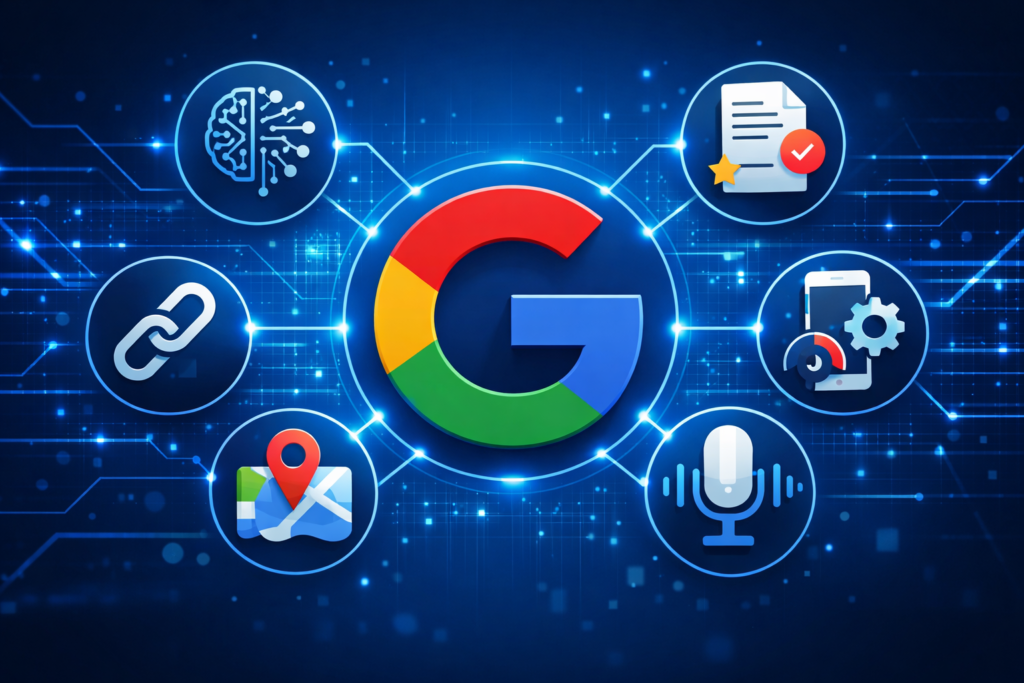
At its core, a Google algorithm is a set of rules and calculations used to retrieve data from its index and instantly deliver the most relevant results for a query. But here’s the twist—Google doesn’t rely on just one algorithm. It uses hundreds of signals and systems working together. Some focus on content quality, others on links, user behavior, location, freshness, or even how well your site works on a smartphone.
Why so many? Because human searches are messy. We use slang, ask questions, make typos, and change intent halfway through a sentence. Google’s mission is to organize the world’s information and make it universally accessible and useful—and that’s no small task. Algorithms are Google’s way of understanding not just what you typed, but why you typed it.
For website owners, marketers, and SEO professionals, understanding Google algorithms isn’t about gaming the system anymore. It’s about aligning with Google’s goal: serving users first. Over the years, algorithm updates have punished shortcuts and rewarded genuine value. If you’ve ever seen your rankings jump or drop overnight, you’ve already felt their power.
In this guide, we’ll walk through all major Google search engine algorithms, explain what they do in plain English, and show how they impact rankings today. Whether you’re new to SEO or a seasoned pro, this deep dive will help you see Google search the way Google sees it.
How Google Search Algorithms Evolved Over Time
Google didn’t always have the sophisticated, AI-powered brain it has today. In the early days, search engines were like librarians who only read book titles. If your page repeated a keyword enough times, boom—you ranked. It didn’t matter whether the content made sense or helped anyone. That era was simple, predictable, and incredibly easy to manipulate.
As the web exploded, this approach quickly broke down. Keyword stuffing, hidden text, and spammy backlinks flooded search results. Users were frustrated, and Google knew something had to change. That’s when algorithm evolution kicked into high gear.
The first major shift was toward link-based evaluation, most famously with PageRank. Links became “votes of confidence,” helping Google assess authority. But again, marketers found loopholes—buying links, exchanging links, and building massive low-quality networks.
Next came the quality revolution. Algorithms like Panda and Penguin changed the game by evaluating content quality and link integrity. Suddenly, thin content and shady SEO tactics weren’t just ineffective—they were dangerous.
Then Google moved into semantic search. Instead of matching exact keywords, the engine began understanding meaning, context, and intent. Updates like Hummingbird and later BERT allowed Google to interpret full sentences the way humans do. Search became conversational.
Today, we’re in the AI and machine learning era. Systems like RankBrain and neural matching continuously learn from user behavior. Google doesn’t just follow rules anymore—it adapts. Click patterns, dwell time, and satisfaction signals help refine results in real time.
This evolution tells a clear story: Google algorithms are becoming more human. The closer your content aligns with genuine human needs, the safer you are—no matter how often the rules change.
Core Google Algorithm Updates Explained
If you’ve ever heard the term “Google core update” and felt a pit in your stomach, you’re not alone. Core updates are broad changes to Google’s primary ranking systems, and they can shake up search results across every industry.
Unlike named updates such as Panda or Penguin, core updates don’t target one specific issue. Instead, they reassess how Google evaluates content overall. Think of it like recalibrating a scale. Your content didn’t suddenly become “bad,” but other pages may now be seen as more relevant or authoritative.
Google releases several core updates each year. Some are announced, others quietly roll out over weeks. When they hit, site owners often notice dramatic ranking fluctuations—both positive and negative.
The key thing to understand is this: core updates are not penalties. Google has repeatedly stated that there’s usually nothing to “fix.” Instead, they encourage site owners to focus on:
-
Content quality and depth
-
Expertise and credibility
-
User satisfaction
-
Clear purpose and value
If your site drops after a core update, it’s often because competitors are doing a better job of answering user intent. The solution isn’t chasing algorithm rumors—it’s improving content holistically.
In many ways, core updates reflect Google’s long-term vision. Each update nudges the ecosystem toward better information, less manipulation, and more trust. When you align your site with those principles, core updates become opportunities instead of threats.
Google Panda Algorithm
Launched in 2011, the Google Panda algorithm was a wake-up call. Before Panda, the internet was flooded with low-quality content farms—sites pumping out hundreds of shallow articles designed purely to rank. Panda changed that overnight.
Panda’s mission was simple but powerful: reward high-quality content and demote thin, low-value pages. Instead of evaluating pages individually, Panda often assessed entire sites. That meant a handful of weak pages could drag down your whole domain.
So what does Panda consider “quality”? While Google never released an exact checklist, patterns emerged over time:
-
Original, in-depth content
-
Clear expertise and authority
-
Low ad-to-content ratio
-
Good user engagement
-
Minimal duplication
Sites with scraped content, excessive ads, or auto-generated text were hit hard. Recovery wasn’t instant either. Improving content quality required patience, pruning bad pages, and adding real value.
Eventually, Panda became part of Google’s core algorithm, meaning it now runs continuously rather than as a one-time update. Its legacy lives on in every quality-focused update that followed.
The lesson from Panda still holds today: content exists for users, not search engines. If your page wouldn’t satisfy a real person, Panda—and its modern descendants—will notice.
Google Penguin Algorithm
If Panda was about content, Penguin was about links. Introduced in 2012, the Google Penguin algorithm targeted manipulative link practices that had been boosting rankings unfairly for years.
Back then, links were currency. The more you had—especially with exact-match anchor text—the higher you ranked. This led to paid links, private blog networks, comment spam, and all sorts of shady tactics.
Penguin flipped the script by identifying unnatural link patterns. Instead of rewarding sheer volume, it evaluated link quality and relevance. Red flags included:
-
Over-optimized anchor text
-
Links from irrelevant or spammy sites
-
Sudden spikes in backlinks
-
Paid or exchanged links
Early versions of Penguin were brutal. A site could lose visibility almost overnight and remain stuck until the next update. Later, Google softened the blow by making Penguin real-time and more granular, devaluing bad links instead of outright penalizing sites.
Today, Penguin is part of Google’s core algorithm, quietly working in the background. Its message is clear: earn links, don’t manufacture them.
Natural backlinks come from great content, strong branding, and genuine relationships. If you focus on those, Penguin becomes irrelevant—in the best possible way.
Google Hummingbird Algorithm
When Google introduced the Hummingbird algorithm in 2013, it marked a fundamental shift in how search queries were interpreted. Before Hummingbird, Google mostly focused on individual keywords within a query. After Hummingbird, Google began looking at the entire meaning behind a search. In simple terms, Google stopped reading like a robot and started listening like a human.
Hummingbird was designed to support semantic search, which means understanding context, intent, and relationships between words. For example, instead of matching the keyword “best phone camera,” Google now understands that the user might be looking for reviews, comparisons, or photography-focused smartphones—even if those exact words aren’t present.
This update became especially important with the rise of voice search. People don’t speak the way they type. We ask questions naturally: “What’s the best phone for taking pictures at night?” Hummingbird allows Google to process these conversational queries accurately.
From an SEO perspective, Hummingbird changed content strategy forever. Keyword stuffing became obsolete. Instead, content creators had to focus on:
-
Topic relevance rather than exact keywords
-
Answering user questions clearly
-
Structuring content logically
-
Using natural language
Hummingbird doesn’t penalize sites—it rewards those that provide comprehensive answers. Long-form content, FAQs, and well-structured guides gained prominence because they align perfectly with semantic understanding.
In essence, Hummingbird taught us that SEO is no longer about keywords—it’s about meaning. If your content satisfies intent, Hummingbird is already on your side.
Google Pigeon Algorithm
Local search used to feel like the wild west—results were inconsistent, inaccurate, and often spammy. Enter the Google Pigeon algorithm in 2014, designed to bring order and relevance to local search results.
Pigeon strengthened the connection between Google’s core algorithm and local search. It improved how Google interpreted location-based queries, such as “coffee shop near me” or “best dentist in Chicago.” Suddenly, proximity, distance, and local authority mattered more than ever.
One of Pigeon’s biggest changes was its impact on local directories. Platforms like Yelp, TripAdvisor, and Yellow Pages saw ranking boosts because Google trusted their structured local data. At the same time, low-quality local business sites lost visibility.
Key ranking factors after Pigeon included:
-
Accurate NAP (Name, Address, Phone number)
-
Strong Google Business Profile optimization
-
Local backlinks
-
User reviews and ratings
For small businesses, Pigeon was both a challenge and an opportunity. Those who invested in local SEO thrived, while others faded into obscurity.
Pigeon reinforced a simple truth: local relevance beats global authority when it comes to nearby searches. If your business serves a local audience, optimizing for Pigeon isn’t optional—it’s survival.
Google Mobile-Friendly Update (Mobilegeddon)
In 2015, Google dropped a bombshell announcement: mobile-friendliness would become a ranking factor. The update quickly earned the nickname Mobilegeddon, and for good reason.
At the time, mobile searches had officially surpassed desktop searches. Yet millions of websites were still designed only for large screens. Google stepped in to protect users from pinching, zooming, and squinting their way through bad experiences.
The mobile-friendly update evaluated pages based on:
-
Responsive design
-
Readable text without zooming
-
Proper spacing of links and buttons
-
Fast mobile load times
Sites that failed these tests saw immediate drops in mobile rankings. Those that passed gained a competitive edge.
This update later evolved into mobile-first indexing, meaning Google primarily uses the mobile version of a site for indexing and ranking—even for desktop users.
The takeaway is crystal clear: if your site doesn’t work on mobile, it doesn’t work—period. Mobile optimization is no longer a technical upgrade; it’s a foundational requirement for visibility.
Google RankBrain Algorithm
RankBrain was Google’s first major leap into machine learning, and it quietly changed search forever. Launched in 2015, RankBrain helps Google interpret unfamiliar or ambiguous queries—something that happens millions of times every day.
Instead of relying solely on predefined rules, RankBrain learns from user behavior. It analyzes how people interact with search results and adjusts rankings accordingly. If users click a result, stay on the page, and don’t bounce back, RankBrain takes that as a positive signal.
Key behavioral signals RankBrain considers include:
-
Click-through rate (CTR)
-
Dwell time
-
Bounce rate
-
Query refinement
RankBrain also helps Google understand synonyms and related concepts. A page doesn’t need to contain an exact phrase to rank—it just needs to satisfy the intent.
For content creators, RankBrain emphasizes one thing above all else: user satisfaction. You can optimize titles, keywords, and meta descriptions all you want—but if users aren’t happy, RankBrain will notice.
Think of RankBrain as Google’s intuition. It learns what works, what doesn’t, and constantly refines results to match real human preferences.
Google Medic Update
The Medic Update rolled out in 2018 and sent shockwaves through industries like health, finance, and legal services. Sites offering medical advice, financial guidance, or life-impacting information saw dramatic ranking changes almost overnight.
Why? Because Google began heavily emphasizing E-E-A-T:
-
Experience
-
Expertise
-
Authoritativeness
-
Trustworthiness
These are known as Your Money or Your Life (YMYL) topics—areas where misinformation can cause real harm. Google raised the bar to protect users.
Signals associated with the Medic Update included:
-
Clear author credentials
-
Accurate, well-sourced information
-
Strong brand reputation
-
Secure websites (HTTPS)
Sites with vague authorship, questionable claims, or weak trust signals were hit hardest.
The Medic Update wasn’t a one-time event—it was a mindset shift. Google made it clear that credibility matters as much as content quality, especially when users’ well-being is at stake.
Google BERT Algorithm
In 2019, Google introduced BERT (Bidirectional Encoder Representations from Transformers)—a mouthful that fundamentally changed how search understands language.
BERT focuses on context. It analyzes words in relation to all other words in a sentence, rather than one at a time. This helps Google grasp nuance, prepositions, and subtle meaning.
For example, the query “2019 brazil traveler to usa need a visa” used to confuse search engines. With BERT, Google understands who is traveling and what they need.
BERT doesn’t change rankings directly. Instead, it improves relevance by matching queries with the most appropriate content.
For SEO, BERT reinforces an ongoing trend: write naturally for humans. Clear explanations, well-structured sentences, and conversational language win.
If Hummingbird taught Google to understand meaning, BERT taught it to understand language itself.
Google Helpful Content Update
The Helpful Content Update, launched in 2022, was Google’s response to a flood of low-value, AI-generated, search-engine-first content. Its goal was simple: reward people-first content and demote content written solely to rank.
This update introduced a site-wide signal. If a significant portion of your content is unhelpful, your entire site could be affected.
Google evaluates whether content:
-
Demonstrates first-hand experience
-
Provides original insights
-
Fully answers questions
-
Leaves users satisfied
The message is loud and clear: content should help users without needing to visit another page.
Ironically, this update doesn’t ban AI—but it punishes content that lacks value. Human experience, opinions, and depth matter more than ever.
Helpful content isn’t about perfection—it’s about usefulness.
Google Spam Updates
Google regularly releases spam updates to combat manipulation. These updates target tactics like:
-
Cloaking
-
Keyword stuffing
-
Auto-generated content
-
Link spam
-
Hacked websites
Spam updates are often swift and unforgiving. Sites engaging in black-hat SEO can lose visibility overnight.
The safest strategy? Don’t flirt with shortcuts. Google’s spam detection is increasingly sophisticated, and recovery is rarely quick.
Clean SEO isn’t just ethical—it’s practical.
How Google Algorithms Work Together
Google algorithms don’t operate in isolation. They form an ecosystem, each evaluating different signals. Content quality, links, user behavior, location, freshness, and usability all interact.
Think of it like a jury. Each algorithm casts a vote, and the final ranking reflects the collective decision.
This is why chasing one update rarely works. Sustainable SEO means aligning with the entire system.
How to Optimize for All Google Algorithms
Here’s the universal strategy that works across updates:
-
Create in-depth, original content
-
Focus on user intent
-
Improve page experience
-
Earn natural backlinks
-
Build trust and authority
If your site genuinely helps users, algorithm updates become allies—not enemies.
Future of Google Search Algorithms
The future of Google search is AI-driven, multimodal, and hyper-personalized. Expect more voice search, visual search, and real-time results.
Google isn’t replacing humans—it’s trying to understand them better.
Conclusion
Google search engine algorithms have evolved from simple keyword matchers into intelligent systems that understand language, intent, and trust. While the updates may seem intimidating, they all point in the same direction: serve users first. When you do that, rankings follow naturally.