The New Era of AI-Powered SEO
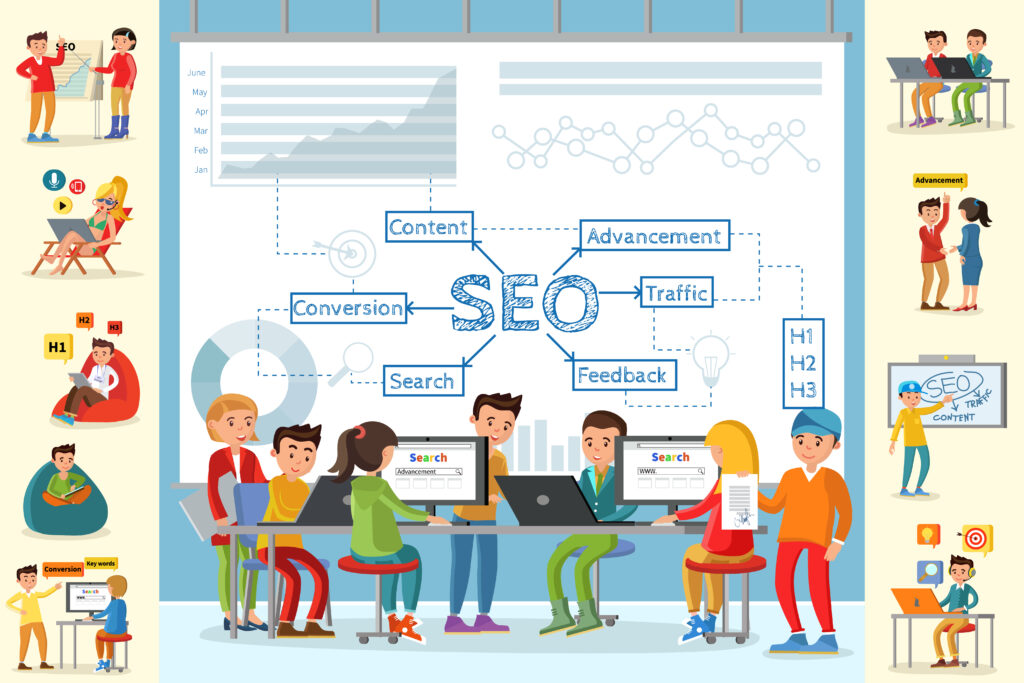
Search engine optimization isn’t what it used to be. If you’ve been in the digital marketing space for even a few years, you’ve probably noticed how quickly things change. One day you’re stuffing keywords into blog posts, and the next day Google is smarter than ever, judging content by context, intent, and user satisfaction. This is exactly where artificial intelligence steps into the spotlight. AI has quietly become the backbone of modern SEO, reshaping how keyword research is done and how content strategies are built.
Think about it like this: traditional keyword research was similar to fishing with a single hook. You threw in a keyword, waited, and hoped for traffic. AI-driven keyword research, on the other hand, is like casting a smart net that understands where the fish are, what they want, and when they’re most active. Instead of relying on gut feeling or outdated metrics, AI analyzes massive datasets, user behavior, and search patterns in real time. That’s a game-changer.

Using AI for keyword research and SEO isn’t about replacing human creativity. It’s about enhancing it. AI helps uncover opportunities you might never notice on your own, from emerging trends to deeply hidden long-tail keywords. It also helps align your content with what users actually want, not just what you think they want. In this blog post, we’ll walk through exactly how to use AI for keyword research and SEO in a practical, human-centered way—no fluff, no buzzwords, just real strategy that works.
Understanding the Role of AI in Modern SEO
Artificial intelligence is no longer a futuristic concept in SEO; it’s already here and deeply embedded in how search engines operate. Google’s algorithms themselves rely heavily on AI systems like RankBrain, BERT, and other machine-learning models to interpret search queries and rank content. So, if search engines are using AI to understand content, it only makes sense that marketers use AI to create and optimize it.
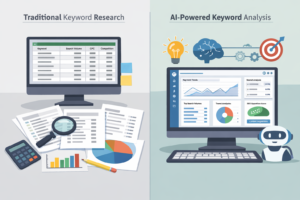
Traditional SEO tools mostly rely on historical data. They tell you what worked in the past: search volume, keyword difficulty, and backlinks. AI-powered SEO tools go several steps further. They analyze patterns, predict outcomes, and understand relationships between words, topics, and user intent. Instead of just showing you a keyword, AI explains why that keyword matters and how it fits into a broader topic ecosystem.
Another key difference is adaptability. AI systems learn continuously. As user behavior changes, AI updates its understanding. This means your keyword strategy can evolve in real time rather than lag behind trends. For example, if users suddenly start searching for a new phrase or asking questions differently, AI tools can detect that shift early and recommend content adjustments before your competitors even notice.
In modern SEO, AI acts like a strategic partner. It processes overwhelming amounts of data at lightning speed, leaving you free to focus on storytelling, branding, and user experience. When used correctly, AI doesn’t make SEO robotic—it makes it smarter, faster, and more aligned with real human behavior.
What Is Keyword Research and Why It Still Matters
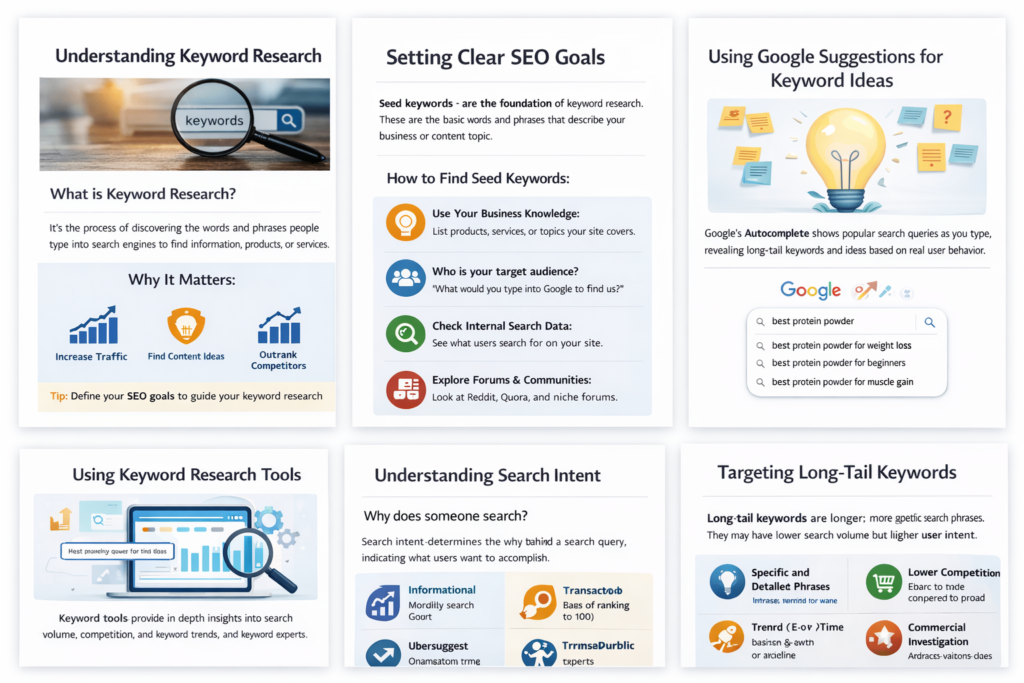
Some people claim keyword research is dead. That couldn’t be further from the truth. Keyword research hasn’t disappeared; it has evolved. At its core, keyword research is still about understanding how people search, what words they use, and what problems they’re trying to solve. The difference today is that keywords are no longer isolated phrases—they’re part of a much bigger context.
In the early days of SEO, ranking was often as simple as repeating a keyword enough times. Search engines were basic, and users adapted to their limitations. Today, users expect search engines to understand nuance, tone, and intent. That’s why modern keyword research focuses less on exact-match phrases and more on topics, entities, and semantic relevance.
AI helps redefine keyword research by connecting keywords to intent. Instead of asking, “How many people search for this term?” AI asks, “Why are they searching for it?” This shift is crucial. Two keywords with the same search volume can have completely different goals behind them. One might indicate curiosity, while the other signals readiness to buy.
Keyword research still matters because it’s the bridge between your content and your audience. Without it, you’re essentially talking to yourself. AI simply makes that bridge stronger by revealing deeper insights into user behavior, preferences, and expectations. When you understand those elements, your content doesn’t just rank—it resonates.
How AI Transforms Keyword Discovery
Keyword discovery used to be a slow, manual process. You’d brainstorm ideas, plug them into a tool, export spreadsheets, and try to make sense of endless rows of data. AI flips this entire process on its head. Instead of starting with assumptions, AI starts with evidence—real-world data drawn from search engines, social platforms, forums, and user interactions.
One of the most powerful ways AI transforms keyword discovery is through semantic analysis. Rather than treating keywords as standalone phrases, AI understands relationships between words. For example, it knows that “AI keyword research,” “SEO automation,” and “machine learning for SEO” are related concepts, even if they don’t share exact wording. This allows you to build content that covers an entire topic comprehensively instead of chasing individual keywords.
AI also excels at pattern recognition. It can identify rising trends before they become mainstream, helping you publish content at the perfect moment. Imagine spotting a keyword trend months before your competitors and establishing authority early. That’s the kind of advantage AI provides.

Another transformation lies in efficiency. What once took days of research can now be done in minutes. AI filters out noise, prioritizes high-impact keywords, and groups them into logical clusters. This doesn’t just save time—it improves accuracy. You spend less energy guessing and more time creating content that truly meets user needs.
Types of AI Tools for Keyword Research
Not all AI SEO tools are created equal, and understanding their categories helps you use them more effectively. Some tools focus on keyword generation, others on competitive analysis, and some on semantic understanding. Together, they form a complete keyword research ecosystem.
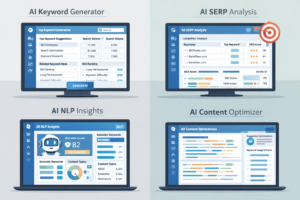 AI-powered keyword generators use machine learning to suggest keywords based on seed terms, user intent, and real-time trends. These tools often go beyond traditional metrics by highlighting relevance, topical authority, and conversion potential. Instead of dumping thousands of keywords on you, they prioritize quality over quantity.
Another category includes AI-driven SERP analysis tools. These tools analyze top-ranking pages and identify common themes, keyword patterns, and content structures. They help answer questions like: Why is this page ranking? What keywords is it implicitly targeting? What topics does Google expect to see for this query?
Natural language processing tools focus on understanding how humans actually speak and write. They analyze questions, conversational phrases, and related entities, making them especially useful for voice search and long-form content. When combined, these AI tools give you a 360-degree view of keyword opportunities, turning raw data into actionable strategy.
Using AI to Identify Search Intent
Search intent is the heartbeat of SEO. You can rank for a keyword, but if your content doesn’t match the intent behind that keyword, traffic won’t convert. AI shines here because it can analyze intent at scale, something humans struggle to do consistently.
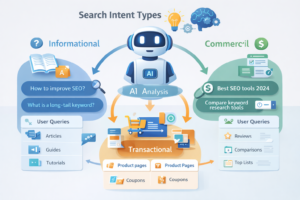 AI categorizes keywords into intent types such as informational, navigational, transactional, and commercial. But it doesn’t stop there. Advanced AI tools look at SERP features, content formats, and user engagement signals to determine what kind of content best satisfies a query. For example, if a keyword consistently triggers comparison articles or product reviews, AI recognizes commercial intent—even if the keyword itself sounds informational.
This insight helps you align content with goals. If you’re targeting informational intent, AI might recommend guides, tutorials, or explainers. For transactional intent, it might suggest landing pages, product descriptions, or pricing pages. This alignment improves not just rankings, but user satisfaction and conversions.
Understanding intent also prevents wasted effort. Instead of forcing a blog post to rank for a keyword that clearly favors product pages, AI guides you toward smarter decisions. It’s like having a map that shows not just where users are going, but why they’re going there.
AI for Long-Tail Keyword Research
Long-tail keywords are often overlooked, yet they’re where real SEO magic happens. These are longer, more specific search queries that usually have lower competition and higher conversion rates. AI is particularly powerful when it comes to uncovering these hidden gems.
Traditional tools might show you obvious variations of a keyword, but AI digs deeper. It analyzes questions from forums, voice searches, and conversational queries to identify phrases real people use. These insights are gold because they reflect genuine problems, not just popular terms.
AI also helps group long-tail keywords by intent and topic. Instead of creating separate pages for each phrase, you can build comprehensive content that naturally incorporates multiple long-tail variations. This approach improves topical authority and keeps content from feeling forced or repetitive.
Long-tail keywords are also more resilient to algorithm updates. Because they’re closely aligned with user intent, content targeting them tends to age well. AI ensures you don’t miss these opportunities, helping you attract qualified traffic that’s more likely to engage, subscribe, or buy.
Competitor Analysis with AI
Competitor analysis has always been a core part of SEO, but AI takes it to a completely different level. Instead of manually checking competitor pages, guessing which keywords they target, or relying on surface-level metrics, AI dives deep into their entire content ecosystem. It analyzes what keywords competitors rank for, how their content is structured, which topics they dominate, and where they’re leaving gaps you can exploit.
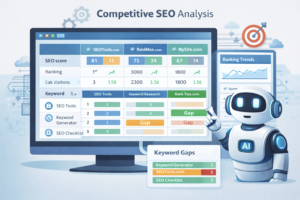 AI tools can reverse-engineer competitor strategies by scanning thousands of pages in seconds. They identify patterns such as keyword frequency, semantic relevance, internal linking strategies, and even content freshness. This means you’re no longer just copying what competitors do—you’re understanding why it works. For example, AI might reveal that a competitor ranks not because of backlinks, but because their content thoroughly addresses user intent with supporting subtopics.
One of the most powerful features of AI-driven competitor analysis is keyword gap identification. AI compares your content with competitors and highlights keywords and topics you haven’t covered yet. These gaps represent low-hanging fruit—opportunities to create content that fills unmet user needs. Instead of competing head-on for oversaturated keywords, you can strategically position yourself where competitors are weak.
AI also helps monitor competitor movements over time. If a competitor suddenly gains rankings, AI can analyze what changed—new content, updated pages, or improved internal linking. This allows you to respond proactively rather than reactively. In short, AI turns competitor analysis from a guessing game into a data-backed strategic advantage.
Content Optimization Using AI Insights
Creating content is only half the battle. Optimizing it so search engines and users both love it is where AI truly shines. AI-powered content optimization tools analyze top-ranking pages and provide actionable recommendations on how to improve your content without sacrificing readability or authenticity.
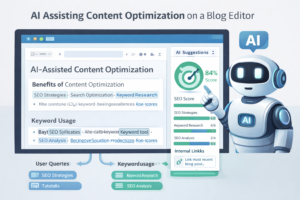 AI evaluates elements such as headings, subheadings, keyword placement, semantic terms, content depth, and readability. It doesn’t just say “add more keywords.” Instead, it suggests contextually relevant phrases, related entities, and questions users expect answers to. This ensures your content feels natural while still being SEO-friendly.
Another major advantage is real-time optimization. AI can analyze your draft as you write and recommend improvements on the fly. For example, it may suggest expanding a section to better match user intent or adding examples to improve engagement. This is especially useful for long-form content where consistency and coverage matter.
AI also helps optimize for user experience. It analyzes bounce rates, dwell time, and engagement signals to determine whether content satisfies users. Based on this data, it may suggest breaking up long paragraphs, adding bullet points, or restructuring sections. The result is content that’s not only optimized for search engines but also genuinely enjoyable to read.
Using AI for Topic Clusters and Content Planning
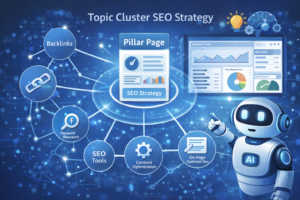 Topic clusters are one of the most effective SEO strategies today, and AI makes building them far easier. Instead of focusing on individual keywords, topic clusters organize content around a central theme, supported by related subtopics. AI excels at identifying these relationships.
AI analyzes search behavior to determine which subtopics users expect when searching for a main keyword. It then groups related keywords into logical clusters, helping you plan content that covers a topic comprehensively. This approach signals topical authority to search engines, increasing your chances of ranking across multiple related queries.
Content planning also becomes more strategic with AI. It helps prioritize which topics to cover first based on search demand, competition, and conversion potential. Instead of guessing what to publish next, you follow a data-driven roadmap that aligns with business goals.
Internal linking is another area where AI adds value. By analyzing content relationships, AI recommends internal links that strengthen topic clusters and improve crawlability. This not only boosts SEO performance but also enhances user navigation, keeping visitors engaged longer.
AI and Voice Search Optimization
Voice search is changing how people interact with search engines. Instead of typing short phrases, users ask full questions in natural language. AI is essential for optimizing content for this shift because it understands conversational queries better than traditional tools.
AI analyzes voice search data to identify common question formats, long-tail phrases, and conversational patterns. This helps you create content that directly answers user questions in a natural, friendly tone. For example, instead of targeting “AI keyword research,” you might optimize for “How can I use AI for keyword research?”
Featured snippets and voice assistant responses often pull from concise, well-structured answers. AI helps identify opportunities to optimize content for these positions by recommending clear headings, short paragraphs, and direct answers.
As voice search continues to grow, especially with smart devices, AI-driven optimization ensures your content stays relevant. It bridges the gap between how humans speak and how search engines interpret language, making your content more accessible and future-proof.
Predictive SEO: Using AI for Trend Forecasting
One of the most exciting aspects of AI in SEO is its predictive power. Instead of reacting to trends after they peak, AI helps you anticipate them. By analyzing historical data, seasonal patterns, and emerging topics, AI forecasts which keywords and topics are likely to grow in popularity.
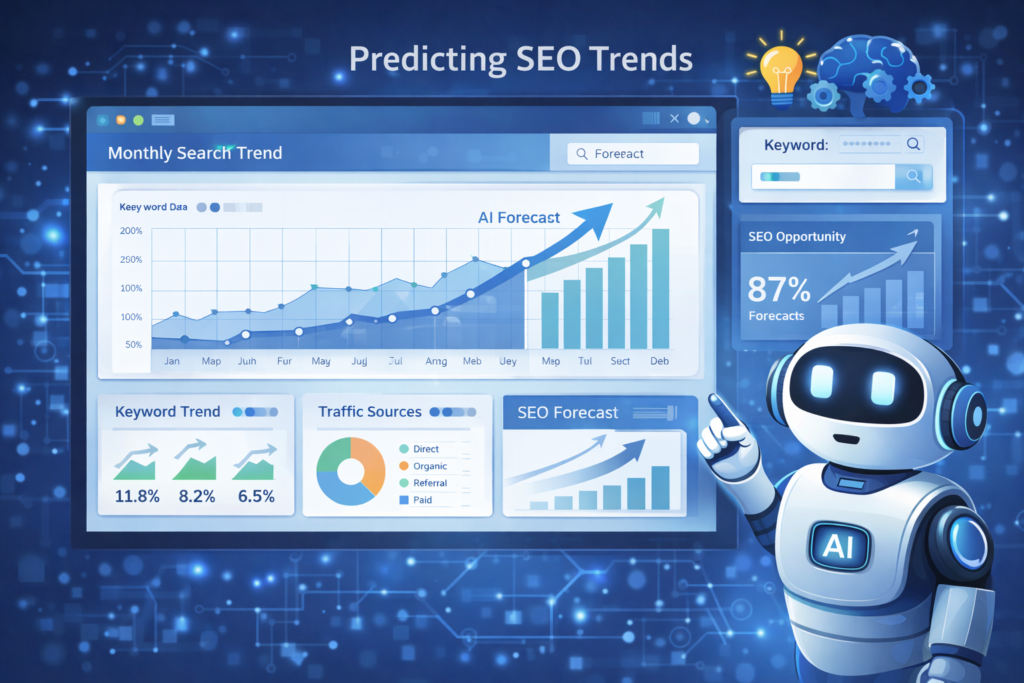
This is incredibly valuable for content planning. Imagine publishing an in-depth guide just as interest in a topic begins to rise. You gain early traction, backlinks, and authority before competition intensifies. AI makes this possible by identifying subtle signals others miss.
Predictive SEO also helps manage seasonal content. AI can recommend when to update or republish content to align with peak demand. This ensures your pages stay relevant and competitive year-round.
Additionally, AI monitors algorithm changes and industry trends, helping you adapt strategies proactively. While no tool can predict every update, AI provides insights that reduce uncertainty and improve long-term SEO resilience.
Common Mistakes When Using AI for SEO
Despite its power, AI isn’t a magic wand. One common mistake is over-automation. Relying entirely on AI-generated suggestions without human judgment can lead to generic or disconnected content. Search engines value authenticity, and users can tell when content lacks a human touch.
Another mistake is ignoring brand voice. AI provides data-driven insights, but it doesn’t understand your brand’s personality unless guided properly. Content should still reflect your unique tone, values, and audience preferences.
Some marketers also misuse AI by chasing every keyword suggestion. Not every opportunity aligns with your goals. AI should support strategy, not replace it. Filtering insights through a clear content vision is essential for sustainable success.
Best Practices for Combining AI and Human Strategy
The most successful SEO strategies use AI as a partner, not a replacement. This “human-in-the-loop” approach ensures data-driven decisions are balanced with creativity and empathy. AI handles analysis and pattern recognition, while humans focus on storytelling, emotion, and trust.
Start by using AI to gather insights, then apply human judgment to prioritize and execute. Review AI recommendations critically, asking whether they align with user needs and business goals. This collaboration leads to content that’s both optimized and authentic.
Ethical SEO practices also matter. Avoid manipulating algorithms or producing low-quality content at scale. AI should enhance value, not dilute it. Sustainable SEO focuses on helping users, and AI is most effective when aligned with that principle.
Future of AI in Keyword Research and SEO
The role of AI in SEO will only grow. As search engines become more sophisticated, AI-driven strategies will become the norm rather than the exception. We’ll see deeper integration of user behavior, personalization, and real-time optimization.
Future AI tools will likely focus more on intent prediction, content personalization, and cross-channel insights. Keyword research will evolve into topic intelligence, where understanding user journeys matters more than individual queries.
Those who embrace AI early and use it thoughtfully will have a competitive edge. The goal isn’t to game the system—it’s to understand users better than ever before.
Conclusion
Using AI for keyword research and SEO isn’t about shortcuts or automation for its own sake. It’s about working smarter. AI helps uncover insights hidden in massive datasets, align content with user intent, and adapt to changing search behavior. When combined with human creativity and strategic thinking, AI becomes a powerful ally in building sustainable, high-performing SEO strategies.
SEO is no longer just about ranking—it’s about relevance, value, and trust. AI gives you the tools to achieve all three, as long as you use them responsibly and creatively.
FAQs
1. Can AI completely replace traditional keyword research tools?
AI enhances traditional tools by adding context, intent analysis, and predictive insights, but it works best when combined with human strategy.
2. Is AI-generated keyword data reliable?
Yes, when sourced from reputable tools. AI analyzes large datasets, making its insights often more accurate than manual research alone.
3. How does AI help with content ranking?
AI aligns content with user intent, optimizes structure, and ensures topical coverage, increasing relevance and engagement.
4. Are AI SEO tools suitable for small businesses?
Absolutely. Many AI tools scale to different budgets and can save time while improving results.
5. Does using AI for SEO violate search engine guidelines?
No, as long as AI is used to create helpful, high-quality content for users rather than manipulate rankings.